
We're Building More Clean Energy Than Ever. So Why Are We Wasting It?

Something doesn’t add up on the U.S. grid
We are building more solar and wind than ever before. Clean energy capacity is growing fast.
At the same time, the world’s largest companies made bold commitments.
Google wants to run on 24/7 carbon-free energy by 2030. Microsoft wants to be carbon negative. Apple and Meta have similar goals (Environmental Report 2024).
These commitments were made years ago, before the AI and data center boom.
Now electricity demand is rising much faster than expected. Data centers are expanding. AI workloads are scaling. And suddenly, these commitments are becoming much harder to meet.
The paradox
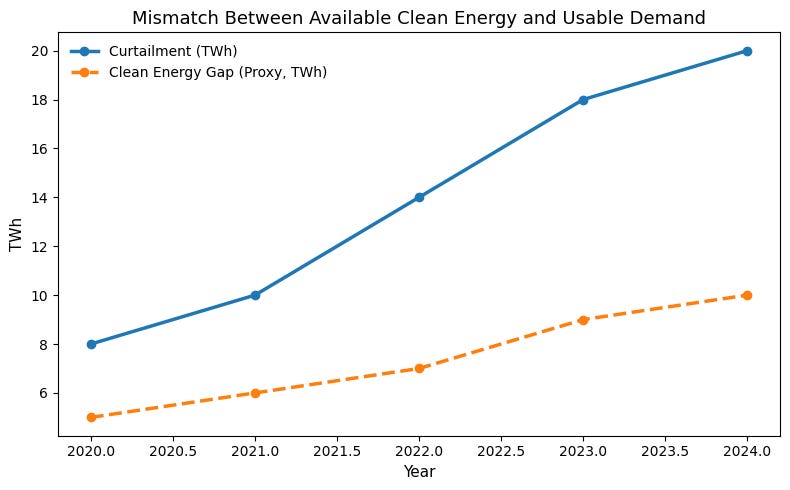
In 2024, the U.S. curtailed around 20 million MWh of renewable electricity (EIA, LBNL). This is clean energy that was already generated, but could not be used.
That is enough to power roughly 2 million homes for a year.
At the same time, companies are still far from running fully on clean power.
Google reports that its operations are only about 60–65% carbon-free on an hourly basis. That means a large share of its electricity still comes from fossil sources, even while clean energy is being wasted somewhere else on the grid.
1 See footnote on chart methodology
So we are doing three things at the same time.
We are building more clean energy.
We are wasting clean energy.
We still don’t have enough clean energy where it is needed.
That should not be possible. But it is.
So…this is not a supply problem
This is not because we failed to build enough solar or wind. The electricity already exists.
The problem is where and when.
Clean energy is often generated far from where demand is located. In California, solar generation is strongest in the south, while demand is higher in the north. Transmission lines cannot carry all the power. So during peak hours, solar farms are told to shut down. This is called curtailment.
The same pattern is showing up in Texas, the Midwest, and other regions.
The timing mismatch
There is also a timing problem.
Solar peaks at noon. Demand peaks in the evening. Wind often peaks at night.
These cycles don’t align.
Storage helps, but we don’t have enough of it. Transmission could help, but it takes years, often decades, to build.
Meanwhile, data centers need power 24/7, and in specific locations.
Even if clean energy exists somewhere on the grid, it cannot always reach where the demand is.
The mismatch
The result is a system that is growing supply and wasting supply at the same time.
The supply-demand mismatch chart shows this mismatch. Curtailment is rising, meaning more clean energy is being wasted. At the same time, large electricity consumers still cannot fully match their demand with clean energy on an hourly and regional basis.
These numbers are not directly connected, but they are in the same range. That is what makes the problem visible.
We are wasting clean energy in one part of the system while needing it in another.
The real structure of the problem
Grid congestion, renewable curtailment, and 24/7 clean energy requirements are not separate issues. They reinforce each other.
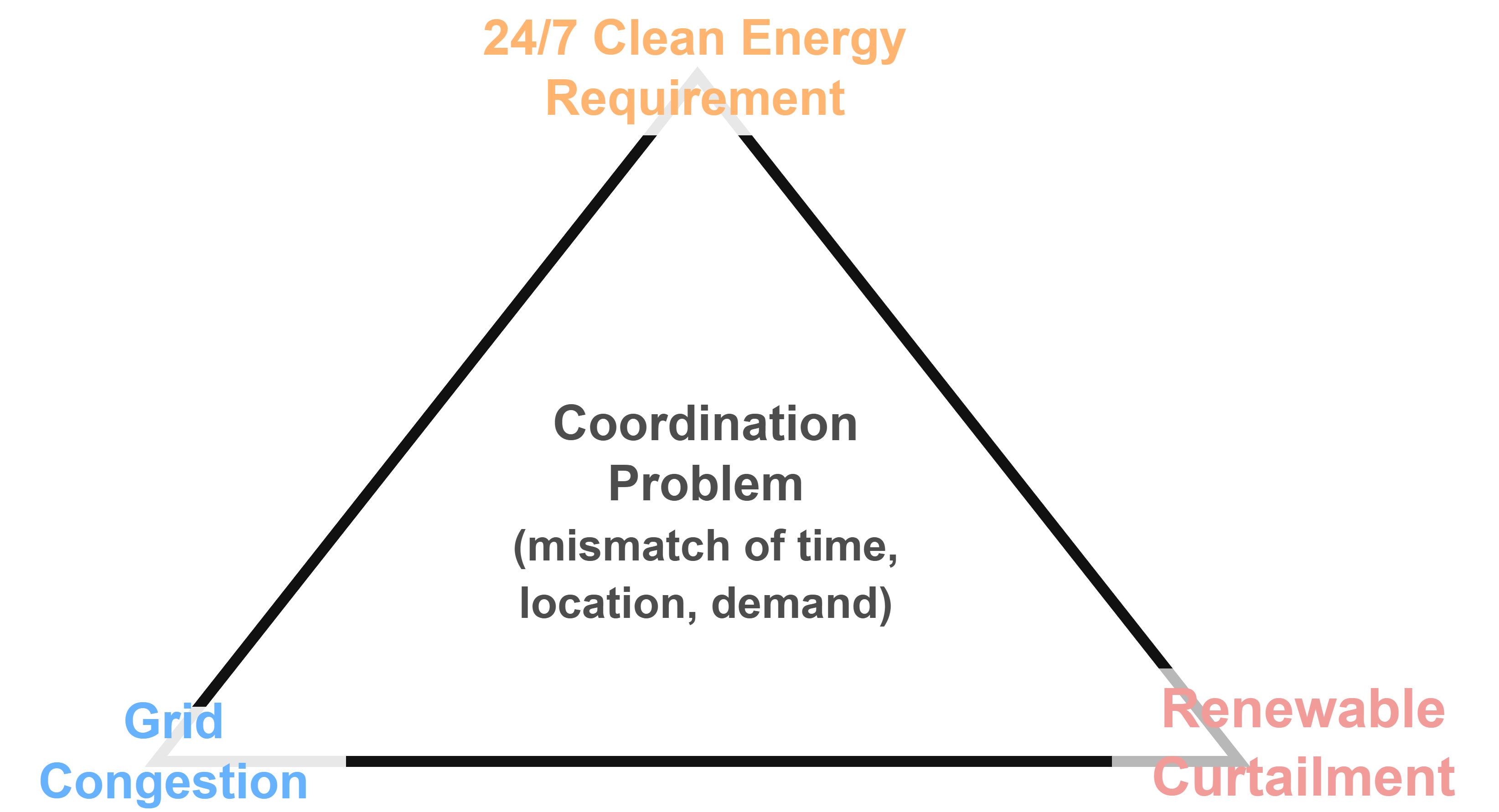
Congestion prevents electricity from moving.
That leads to curtailment.
Curtailment reduces the usable supply of clean energy.
That makes it harder to meet 24/7 clean energy goals.
The conclusion
This is not a supply problem.
This is a coordination problem.
If we are already generating clean energy and throwing it away, the question is no longer how to produce more.
The real question is whether we can better align demand with where and when clean energy is available.
In the next post, I will walk through what that solution looks like, and why it may involve something we do not usually think of as part of the grid at all.
References:
U.S. Energy Information Administration (EIA), Electric Power Monthly, 2024
Lawrence Berkeley National Laboratory (LBNL), Curtailment and Renewable Integration Reports, 2024
Google, Environmental Report 2024
International Energy Agency (IEA), Electricity 2024
U.S. Department of Energy (DOE), National Transmission Needs Study, 2023
Curtailment data based on U.S. Energy Information Administration (EIA) and Lawrence Berkeley National Laboratory (LBNL) reports, indicating approximately ~20 TWh of renewable energy curtailed in 2024.
The “clean energy gap” is a proxy estimate illustrating electricity demand not matched by carbon-free energy on an hourly and locational basis. It is derived from publicly reported data by large data center operators such as Google. Google reports ~64% carbon-free energy (CFE) globally (Environmental Report 2024), implying ~36% not matched by carbon-free energy.
Assuming total electricity consumption of ~25–30 TWh annually for Google, this implies a gap of approximately:
Gap ≈ (1 − 64%) × 25–30 TWh ≈ 9–11 TWh
The values shown (8–10 TWh) represent a conservative approximation based on this range. The two series are not directly linked but illustrate a comparable scale of mismatch between available renewable energy and the ability to use it where and when needed.