
Why Data Centers Go Where They Go — And Where They Should Go Instead

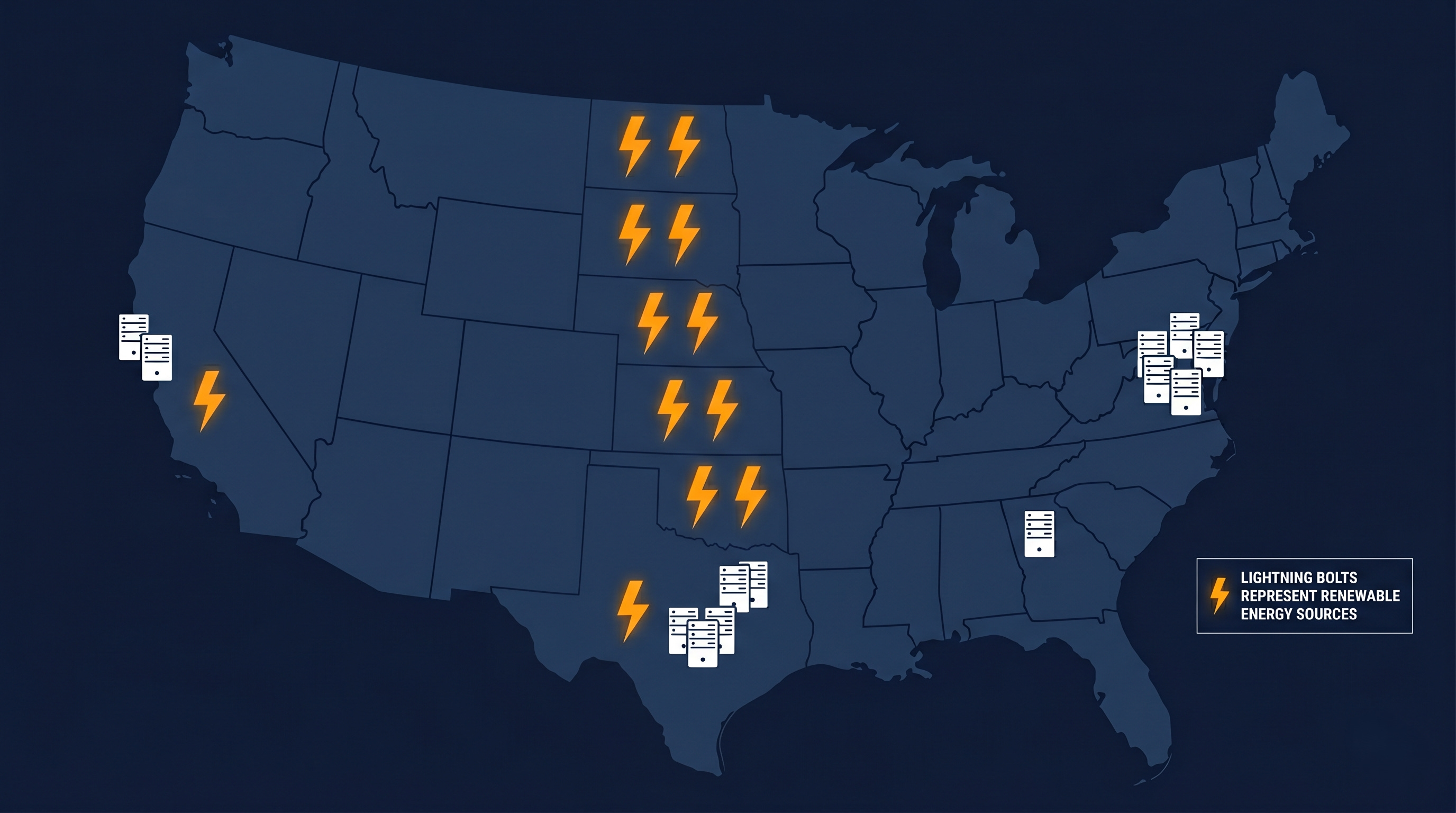
This is a follow-up to my earlier post on data center location attractiveness based on energy price alone. That analysis showed energy cost matters — but it is only one piece of a much larger picture. This post expands the model to seven factors and asks a harder question: where should data centers go if the grid is part of the equation?
The Problem With a Single-Factor Model
In the previous post, I ranked all 50 states on electricity price alone. The results were directionally correct — low-cost states like Iowa, Oklahoma, and Arkansas came out on top. But a data center operator does not choose a location on energy price alone.
They care about tax incentives, water availability for cooling, fiber density for latency, disaster risk, and proximity to customers. Energy price is one input. It is not the decision.
So I rebuilt the model. Seven factors, all scored 1–5 from the operator’s perspective (5 = most favorable). Then a weighted composite score across all 51 geographies (50 states + DC).
The seven factors:
Tax Incentives — state DC tax exemption programs (SDI Alliance / NAIOP)
Water Availability — WRI Aqueduct 4.0 stress score
Fiber / Connectivity — FCC broadband data, share of high-speed providers
Disaster Safety — FEMA National Risk Index
Renewable Curtailment — GWh stranded annually (EIA / Modo Energy / Amperon 2024)
Energy Cost — EIA industrial rates 2024
Fortune 500 Density — corporate HQ count as a proxy for enterprise demand
The full interactive tool is here: abhijitdas.info/energy/dc-location-explorer.html. You can adjust weights and see the rankings shift in real time.
Table 1: Where a Rational Operator Goes (Equal Weights)
With all seven factors weighted equally (~14.3% each), this is the ranking:
Sources: Scores derived from SDI Alliance, WRI Aqueduct 4.0, FCC BDC, FEMA NRI, EIA, Fortune 2024. DC capacity from JLL / Cushman & Wakefield H1 2025.
Texas and Virginia tie at the top with a composite score of 3.86. Virginia scores 5 on tax incentives, 5 on water, 4 on fiber, 4 on disaster safety — but its renewable curtailment is low (~300 GWh) and energy cost is moderate. Texas matches on score but for different reasons: strong tax incentives, large Fortune 500 density, and 8,000 GWh of curtailed renewable energy annually.
The market has broadly tracked this. Northern Virginia — Loudoun County and surroundings — now has over 4,000 MW of installed capacity, the largest data center market in the world. Texas is the second-largest and growing fast.
The equal-weight ranking is consistent with where capital has gone. Virginia, Texas, Georgia, Iowa — these are real markets. The model confirms what the industry already knows.
But look at the curtailment column. Virginia curtails only ~300 GWh annually. Iowa curtails 1,300 GWh. Texas curtails 8,000 GWh. That curtailment is renewable energy generated and then thrown away — because no one is consuming it at the right time. That number matters if your organization has a net-zero commitment or an RE100 target.
Table 2: Where a Green Operator Should Go (Curtailment-Weighted)
Now shift the weights. Set curtailment at 40%, energy cost at 20%, and distribute the remaining 40% across the other five factors at 8% each. This is what I call the Green / RE100 scenario — the weighting a buyer would use if absorbing stranded renewable energy is a primary objective.
Curtailment data: EIA Electric Power Monthly 2024, Modo Energy, Amperon. Green weighting: curtailment 40%, energy cost 20%, other five factors 8% each.
The map changes completely.
Nebraska jumps from rank 12 to rank 2. North Dakota goes from rank 18 to rank 3. Oklahoma, Kansas, South Dakota — all in the bottom half under equal weights — crack the top 10. Virginia, the consensus #1, drops to rank 15.
Texas holds the top spot in both tables. It has the largest renewable curtailment in the country (8,000 GWh/year), strong tax incentives, and already has the infrastructure to support large-scale compute. It is the one state where market reality and green opportunity overlap clearly.
Everywhere else, the gap is stark.
Where the Market Actually Is
Here is the current data center market, sorted by installed capacity:
Three things stand out.
California, New York, Illinois. All score 5 on Fortune 500 density. All rank poorly on equal-weight fundamentals and fall further under green weights. These markets exist because enterprise customers are there — not because the operational or renewable case is strong. California curtails 3,400 GWh of solar annually but its energy cost and tax scores are both 1. Operators are paying a premium to be near their customers.
Florida and Arizona. Florida has a disaster risk score of 1 — hurricane exposure. Arizona scores 1 on water — one of the most water-stressed states in the country. Both rank in the bottom half on fundamentals. These markets have grown on land cost and existing infrastructure, not long-term site quality.
The F500 gap. Oklahoma, Kansas, and Nebraska all score 2 on Fortune 500 density. There is almost no enterprise demand pull in these states. That partly explains why the data center market has not followed the renewable energy. Without nearby enterprise customers, a hyperscale operator building there is betting entirely on latency-insensitive workloads — AI training, batch compute, green hydrogen — rather than serving local enterprise IT demand.
Now look at the other side. Oklahoma, Kansas, Nebraska, North Dakota, and South Dakota collectively curtail roughly 10,000 GWh of renewable energy per year — wind energy generated and thrown away because no load is nearby to absorb it. Combined installed data center capacity across all five states: 27 MW. That is not a typo.
10,000 GWh is enough to power roughly 900,000 average US homes for a year. There is essentially no compute load there to absorb it.
What Explains the Gap?
The obvious answer: data centers need to be near users. Nebraska is far from most enterprise customers.
That is true for latency-sensitive work — financial trading, consumer apps, real-time services. You cannot move those far from the people using them.
But not all compute works that way. AI training jobs run for days or weeks. They do not need fast response times. The job finishes the same way whether the server sits in Omaha or Northern Virginia.
Green hydrogen is the same idea, but even simpler. An electrolyzer splits water into hydrogen using electricity. The electricity has to come from nearby. But the hydrogen can be compressed, stored, and shipped anywhere. Nebraska scores 5 on fiber connectivity. North Dakota scores 4. Both sit on major long-haul backbone routes. The connectivity is already there. What is missing is a large enough industrial load to absorb the wind that is being wasted.
The second gap is infrastructure — but narrower than it sounds. The real issues are three things: power substations sized for large data center loads, workers who know how to build and run them, and specialist contractors. Northern Virginia has all three, built up over 25 years. Nebraska has 2 MW of existing capacity. You are not walking into an ecosystem. You are building one from scratch.
These are real barriers. But they are not permanent. They are coordination problems.
Analysis and Conclusion
The two tables tell different stories.
The equal-weight table describes the world as it is. Virginia wins on operations, infrastructure, and proximity to customers. The market got this right — and Fortune 500 density explains a lot of it. Data centers followed the enterprise customers. Virginia has 4,000+ MW because the buyers were already there.
The green-weight table asks a different question: where can compute absorb the most stranded renewable energy at the lowest cost? The answer is the Great Plains — Kansas, Nebraska, North Dakota, Oklahoma, South Dakota. High curtailment. Cheap power. Almost no data center presence.
The gap is a coordination failure, not a market failure. The renewable energy exists. The compute demand exists. They are not in the same place.
That is starting to change. AI training workloads are different from enterprise IT. A training job runs for days or weeks. It does not need to be close to the user. Nebraska works just as well as Northern Virginia for that. As AI compute grows, operators will start looking beyond established markets — and the Great Plains offers cheap power and stranded wind.
Green hydrogen is the other angle. An electrolyzer uses curtailed wind to split water into hydrogen. The hydrogen gets compressed and shipped anywhere. For heavy duty transportation — long-haul trucks, freight — hydrogen is one of the few realistic zero-emission options at scale. If that path is viable, the infrastructure needs to start now. The wind belt states are the right place to build it.
The curtailment is happening right now. The question is whether operators follow the renewable resource — or keep waiting for it to follow them.
Full interactive model (adjust weights yourself): abhijitdas.info/energy/dc-location-explorer.html
Excel scoring file with all sources and methodology available on request.