
Your Electricity Bill Depends on Where — and When — the Load Goes

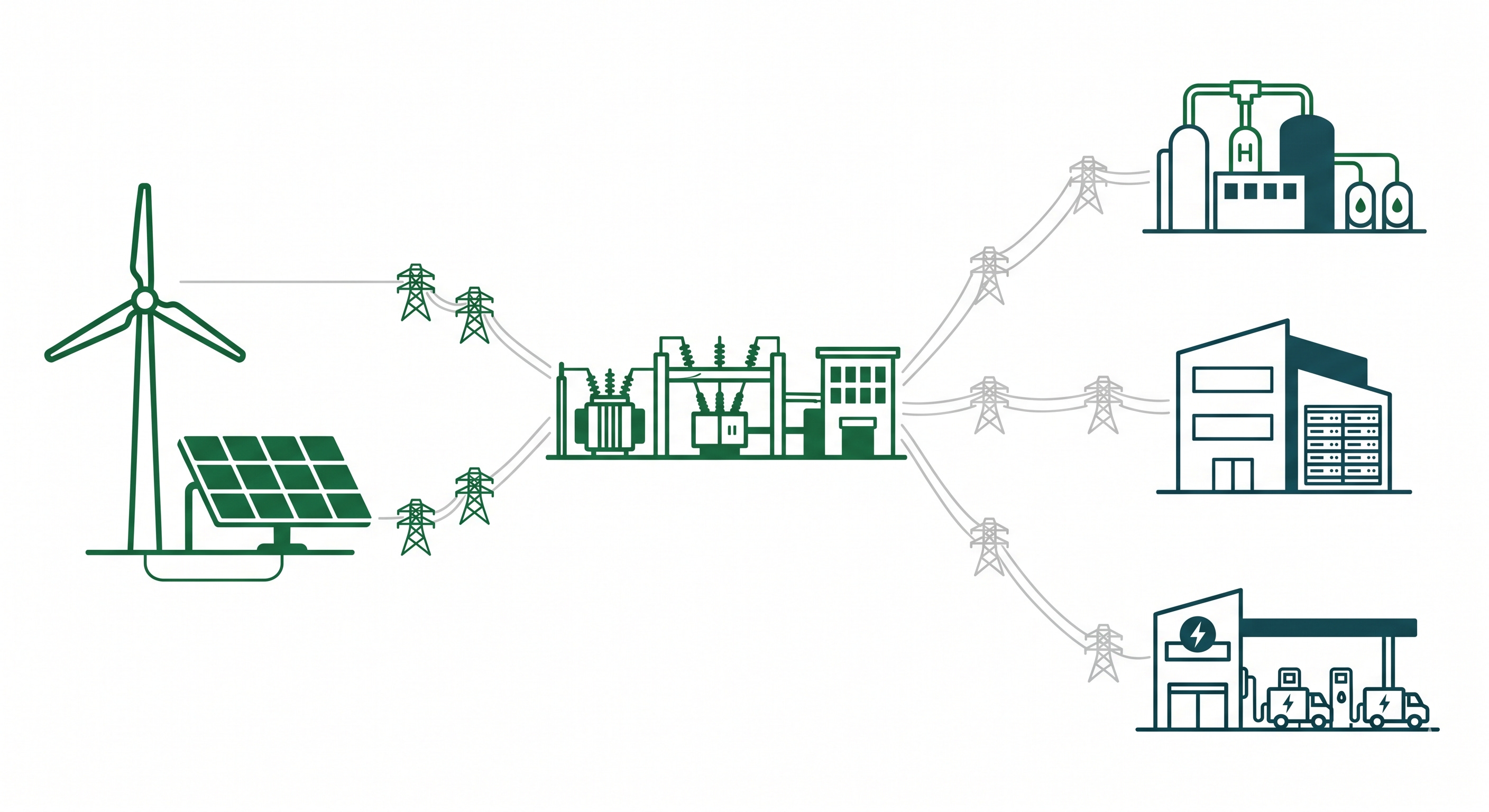
A consulting firm called E3 just published a study on what happens to your electricity bill when trucks go electric (full report).
The short answer: rates go down slightly, or stay flat. Good news (also reported in utility drive).
But the more interesting question is what they didn’t study.
What the paper says
The study looked at medium and heavy-duty trucks — delivery trucks, semi-trucks, buses. Not passenger cars.
The question they asked: if a lot of these trucks switch to electric, does your electricity bill go up or down?
The math is simple. Utilities have fixed costs — power plants, wires, substations. Those costs get divided across all the kilowatt-hours sold. More customers, more sales, lower bill for everyone.
Electric trucks are big electricity consumers. So in theory, they help spread the fixed costs. Rates should go down.
E3 confirmed this — mostly. They studied two utilities: PG&E in northern California and Georgia Power. In most scenarios, electrifying trucks put mild downward pressure on residential rates. Around $20 per year savings in California by 2035.
But there’s a catch.
In California, grid infrastructure is expensive. Upgrades are costly. When E3 used PG&E’s own internal cost estimates instead of the standard ones, the result flipped — rates went up, not down.
So the answer depends heavily on where you are and how much it costs to expand the grid.
The part they didn’t study
E3 studied two utilities, two scenarios. That’s a start, but it’s a narrow slice.
Think of it as a table with three rows and three columns.
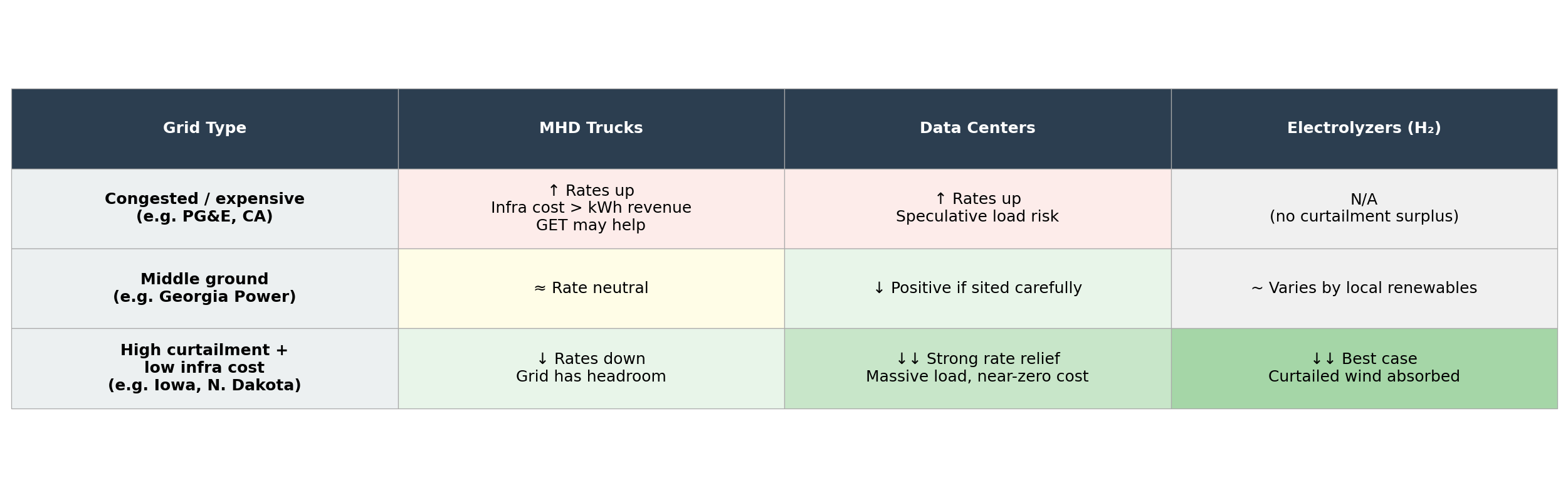
The rows are grid types:
Congested, expensive grid (like California)
Middle ground (like Georgia)
High localized curtailment zones (like North Dakota, Iowa, west Texas)
The columns are load types:
Truck charging
Data centers
Hydrogen production
E3 ran the rate math for column one, rows one and two. They mention data centers and hydrogen in passing — but only to say that data centers worry utilities because companies often reserve grid connections at multiple sites speculatively, without any guarantee the load actually shows up. That puts the cost on ratepayers with no benefit. Trucks, E3 argues, are a safer bet because the load is more distributed and predictable.
That contrast is interesting. But they stop there. They don’t ask what happens when you combine all three load types and put them in the right location.
Why the bottom row is the most interesting
In high-curtailment zones — parts of North Dakota, Iowa, and west Texas — wind turbines produce more electricity than the local grid can carry. That energy gets wasted because there’s no way to move it to where people need it.
Infrastructure costs in these areas are lower. There’s physical room on the grid.
Now add flexible loads — things that can be scheduled, not just plugged in and left on.
E3 already showed that truck charging is flexible. Their managed charging scenario models fleet managers shifting depot charging overnight to hit off-peak rates. That part is settled. But E3 limits this to within a single utility’s service area. The real question is what happens at the macro level — when you pick the location deliberately, based on where energy is being wasted.
Data centers are more flexible. An AI training job doesn’t care if it runs at 2am or 4am.
Hydrogen electrolyzers are the most flexible. You make hydrogen when energy is cheap, store it, use it later. You can turn the electrolyzer on and off freely.
Put all three in a high-curtailment state and the math looks very different from what E3 found. The fixed costs are low. The load is large. The energy would have been wasted anyway — so its marginal cost is near zero.
Rates don’t just go down slightly. They go down a lot.
The connection to my earlier work
I published a paper on SSRN earlier this year arguing that the energy system is coordination-constrained, not supply-constrained. We have enough renewable energy. The problem is getting it to where it’s needed, when it’s needed (paper1, paper2).
Grid-enhancing technologies — better software, smarter line ratings, power flow controllers — can squeeze more out of existing wires. That’s one tool.
Flexible demand — moving consumption to where energy already exists — is another tool.
E3’s managed charging is a version of this. Schedule charging to avoid peaks within your utility territory. Useful, and they proved it reduces rates.
But co-locating flexible loads in high-curtailment zones is a bigger version of the same idea. You’re not just smoothing peaks inside a service area. You’re consuming energy that would otherwise be thrown away — before it even reaches the congested part of the grid.
What comes next
E3’s paper asks: does truck electrification raise or lower my bill?
The more complete question is: what combination of load type, load location, and grid infrastructure produces the best outcome for ratepayers?
Nobody has answered that systematically. That’s the paper I’m working on.
The 3×3 table is the starting point.
If you found this useful, share it. If you have data on curtailment rates or infrastructure costs by utility, I’d like to hear from you.